Uniport’s Ban on Faculty and Departmental Dues Sparks Mixed Reactions Among Students and Student Leaders.
A recent directive from the University of Port Harcourt Student Affairs Department prohibiting the collection of departmental and faculty dues has generated mixed reactions across the university community.
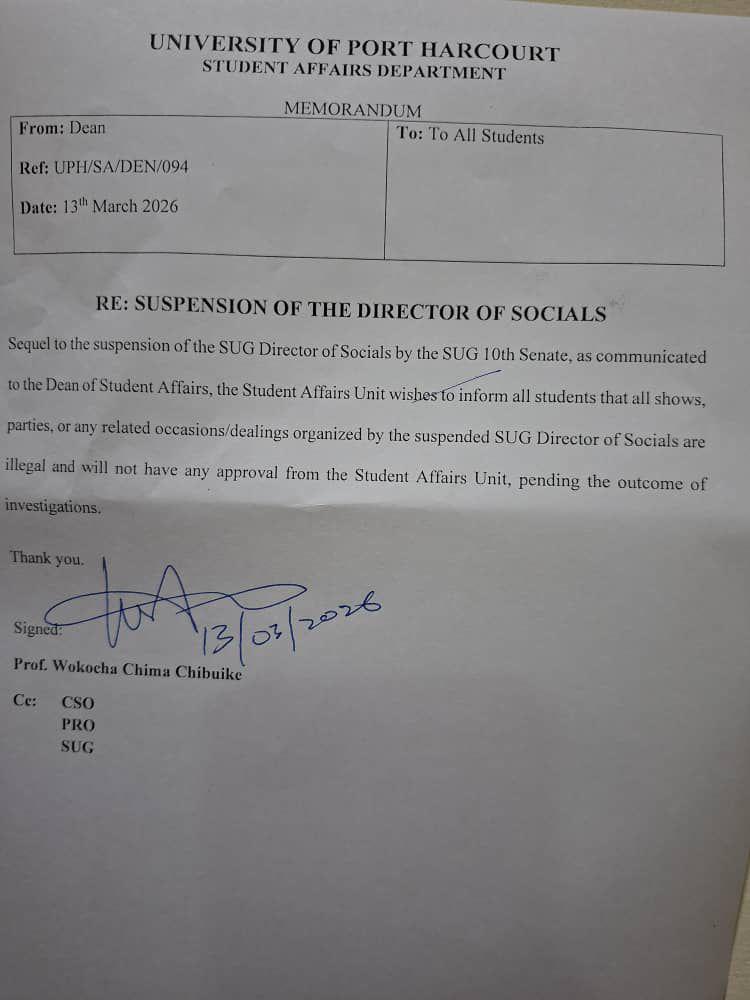
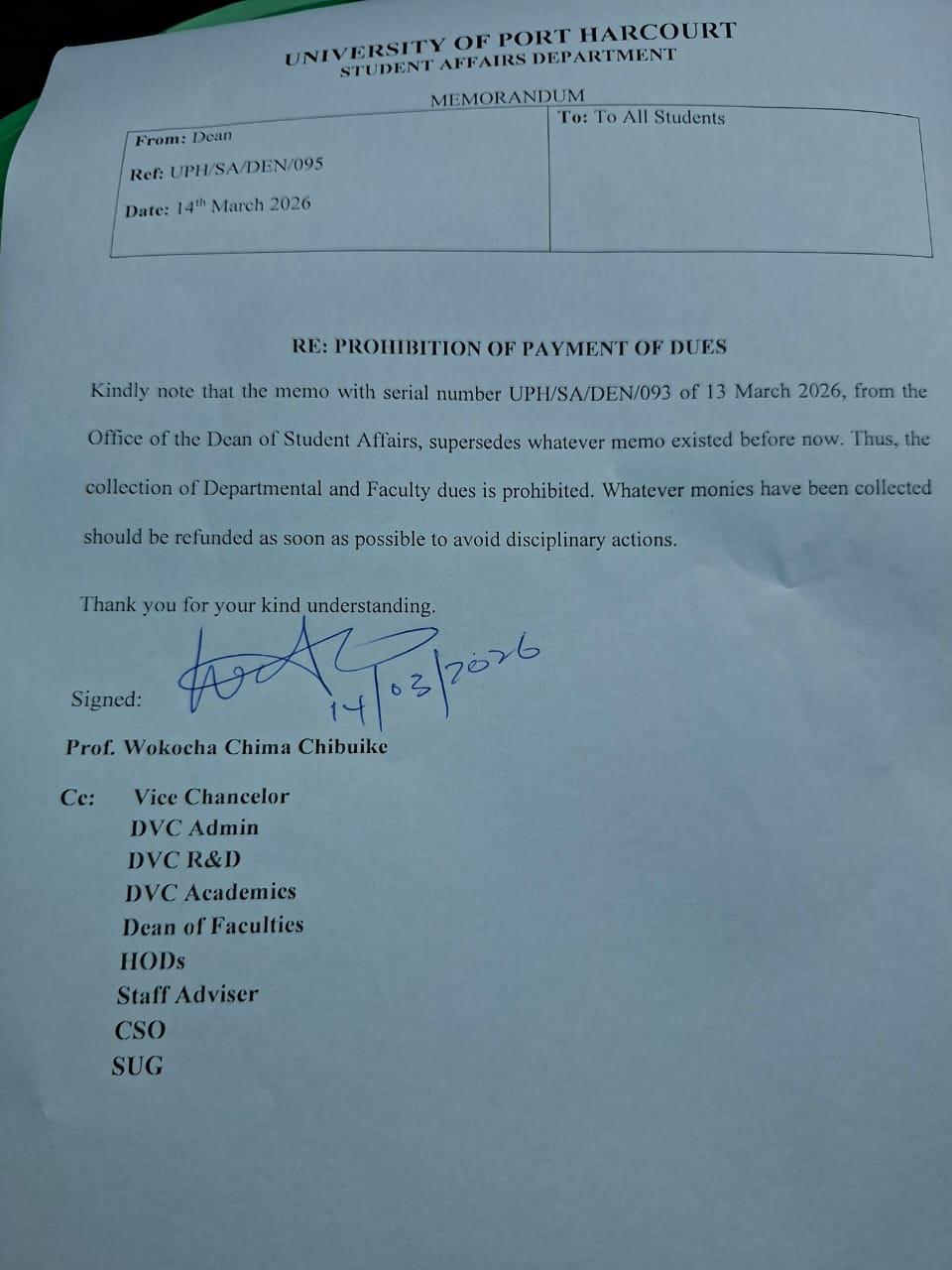
In a memorandum issued by the Dean of Student Affairs, Prof. Chima Chibuike Wokocha, the university announced that the collection of such dues by departments and faculties is now prohibited. The memo also directed that any monies already collected should be refunded immediately to avoid disciplinary actions.
The decision has been widely welcomed by many students who view it as a relief from the numerous financial demands often placed on them during the academic session. For several students, the directive is seen as a step toward reducing the financial burden associated with campus life.
However, the development has not been received with the same enthusiasm by many faculty and departmental student executives. These student leaders argue that departmental and faculty dues have traditionally served as a major source of funding for various academic and social activities. From organizing orientations, seminars, and academic events to supporting departmental programs, such dues have often been the financial backbone for student-led initiatives.
According to some executives, the prohibition may significantly limit their ability to effectively run programs and activities that benefit students within their departments and faculties.
Adding to the complexity of the situation is the directive that already collected dues should be refunded. For many departmental and faculty executives, this presents a major practical challenge. In several cases, funds realized from dues collection have already been committed to or spent on activities such as orientation programmes, departmental events, logistics, and other administrative needs. This has raised a pressing question among student leaders: how exactly will these refunds be made when the funds have already been utilized?
Interestingly, the conversation among students is not entirely one-sided. While many support the prohibition of dues, some students believe the issue requires a more balanced approach. They argue that rather than an outright ban, there should be a proper review and regulation of the charges being imposed.
Some students point out that in certain cases, non-statutory departmental or faculty-related charges have risen to unusually high amounts, with reports of some fees reaching as much as ₦70,000. For these students, the concern is less about the existence of dues and more about the lack of oversight and the excessive amounts sometimes demanded.
Ultimately, the directive has opened a wider conversation about transparency, accountability, and the financial structure of student activities within the university. While many students welcome the relief from financial pressure, student leaders worry about the sustainability of departmental programmes without these funds.
As the discussions continue across the university community, what remains clear is that the issue goes beyond simply collecting or banning dues. It touches on the broader question of how student activities should be funded, regulated, and managed in a way that protects students while still allowing departments and faculties to effectively carry out their programmes. For now, many are watching closely to see how the refund directive will be implemented and whether further clarifications will emerge in the days ahead.
_____________________________________________
We have a WhatsApp channel. Do well to follow for exclusive offers, placements and real time updates;
https://whatsapp.com/channel/0029VbAYOmR05MUbjMcimM00
_____________________________________________
#UniqueStoary #Uniport #ABetterUniport #Editorial #UniportNews #Campus #CampusGist #CampusLife #CampusUpdate #UniportStudents #StudentLifeUniport’s Ban on Faculty and Departmental Dues Sparks Mixed Reactions Among Students and Student Leaders.
A recent directive from the University of Port Harcourt Student Affairs Department prohibiting the collection of departmental and faculty dues has generated mixed reactions across the university community.
In a memorandum issued by the Dean of Student Affairs, Prof. Chima Chibuike Wokocha, the university announced that the collection of such dues by departments and faculties is now prohibited. The memo also directed that any monies already collected should be refunded immediately to avoid disciplinary actions.
The decision has been widely welcomed by many students who view it as a relief from the numerous financial demands often placed on them during the academic session. For several students, the directive is seen as a step toward reducing the financial burden associated with campus life.
However, the development has not been received with the same enthusiasm by many faculty and departmental student executives. These student leaders argue that departmental and faculty dues have traditionally served as a major source of funding for various academic and social activities. From organizing orientations, seminars, and academic events to supporting departmental programs, such dues have often been the financial backbone for student-led initiatives.
According to some executives, the prohibition may significantly limit their ability to effectively run programs and activities that benefit students within their departments and faculties.
Adding to the complexity of the situation is the directive that already collected dues should be refunded. For many departmental and faculty executives, this presents a major practical challenge. In several cases, funds realized from dues collection have already been committed to or spent on activities such as orientation programmes, departmental events, logistics, and other administrative needs. This has raised a pressing question among student leaders: how exactly will these refunds be made when the funds have already been utilized?
Interestingly, the conversation among students is not entirely one-sided. While many support the prohibition of dues, some students believe the issue requires a more balanced approach. They argue that rather than an outright ban, there should be a proper review and regulation of the charges being imposed.
Some students point out that in certain cases, non-statutory departmental or faculty-related charges have risen to unusually high amounts, with reports of some fees reaching as much as ₦70,000. For these students, the concern is less about the existence of dues and more about the lack of oversight and the excessive amounts sometimes demanded.
Ultimately, the directive has opened a wider conversation about transparency, accountability, and the financial structure of student activities within the university. While many students welcome the relief from financial pressure, student leaders worry about the sustainability of departmental programmes without these funds.
As the discussions continue across the university community, what remains clear is that the issue goes beyond simply collecting or banning dues. It touches on the broader question of how student activities should be funded, regulated, and managed in a way that protects students while still allowing departments and faculties to effectively carry out their programmes. For now, many are watching closely to see how the refund directive will be implemented and whether further clarifications will emerge in the days ahead.
_____________________________________________
We have a WhatsApp channel. Do well to follow for exclusive offers, placements and real time updates;
https://whatsapp.com/channel/0029VbAYOmR05MUbjMcimM00
_____________________________________________
#UniqueStoary #Uniport #ABetterUniport #Editorial #UniportNews #Campus #CampusGist #CampusLife #CampusUpdate #UniportStudents #StudentLife



 DMCA
DMCA
 FAQ
FAQ
 Webapp Installation