

 DMCA
DMCA
 FAQ
FAQ
 Webapp Installation
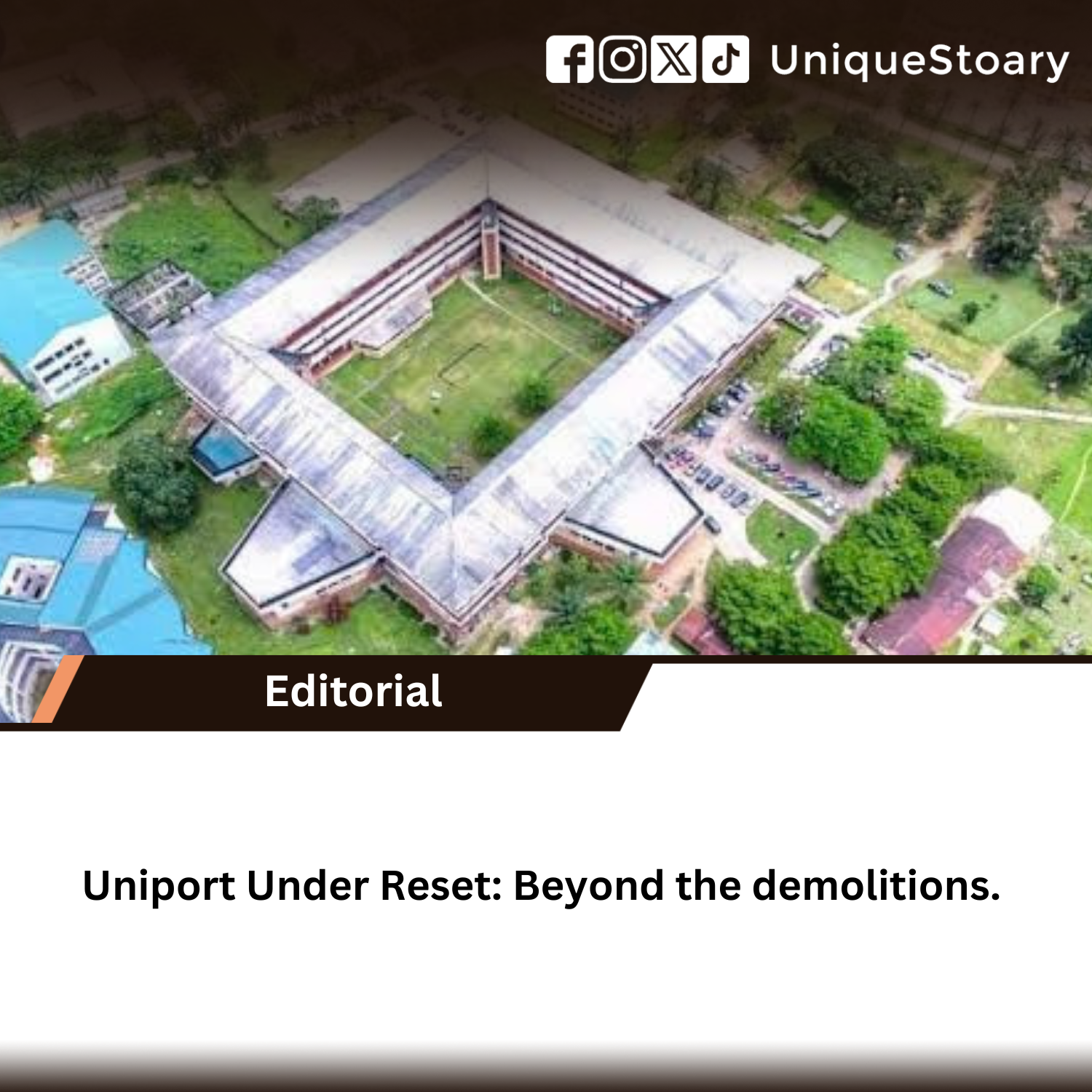
EDITORIAL | Uniport Under Reset: Beyond the demolitions.
The once green and serene landscape of the University of Port Harcourt has changed.
Stands, kiosks, shops and other commercial structures have increasingly become part of the environment. Many provide services students genuinely need and create livelihoods for members of the university community.
Yet, a question remains: When does commercial activity begin to alter the character and purpose of a university space?
On October 2, 2026 the University of Port Harcourt announced that the demolition of what it describes as illegal structures on University premises will commence on today Monday October 5, 2026.
The University says the exercise follows a decision of the Finance and General Purpose Committee of the Governing Council and is intended to restore order, ensure compliance with University regulations and maintain a safe and conducive environment.
The decision brings attention to a larger issue: how did we get here?
Structures do not usually transform a campus overnight. They appear gradually. A temporary stand becomes permanent. One structure becomes several. Commercial activity expands, and eventually, what was once temporary becomes part of the landscape.
That raises questions about planning, approvals, monitoring and enforcement.
If structures require approval, how were they established? Were approvals granted? If not, when was the violation identified? And what system will prevent a similar situation from developing again?
These questions are not necessarily an indictment of any particular administration. They are questions worth asking if the University wants a sustainable approach to campus development.
There is also the human side.
Behind every structure may be someone's investment, business or livelihood. That does not automatically make an unauthorised structure lawful, but it means enforcement has consequences beyond the buildings themselves.
Clear communication will therefore matter.
People should understand what qualifies as an illegal structure, which structures are affected and what procedures apply.
But perhaps the biggest question is not what happens during the demolition, it is what happens afterwards.
If these structures are removed, what happens to the spaces?
Will they remain open? Will properly designated commercial areas be created? Will there be a framework for businesses that genuinely serve the university community?
Demolition can remove structures, only planning can prevent the cycle from returning.
University of Port Harcourt can evolve without losing its identity.
The University can accommodate legitimate commercial activity without allowing commerce to overwhelm the character and purpose of the campus.
This moment, therefore, presents an opportunity—not only to remove structures, but to rethink how University of Port Harcourt manages its spaces.
The question is simple: What should the University of Port Harcourt look like five years from now?
The answer should not be determined only by what we remove today, but by what we decide to build tomorrow.
Unique Stoary...digital heartbeat of Uniport.
📌 Join the Unique Stoary Community on Telegram let's have real time discussions on latest happenings and matters arising in Uniport. Click on this link to join https://t.me/uniquestoary
_____________________________________________
We have a WhatsApp channel. Do well to follow for exclusive offers, placements and real time updates;
https://whatsapp.com/channel/0029VbAYOmR05MUbjMcimM00
_____________________________________________
#UniqueStoary #Editorial #Stoary #Uniport #ABetterUniport
The once green and serene landscape of the University of Port Harcourt has changed.
Stands, kiosks, shops and other commercial structures have increasingly become part of the environment. Many provide services students genuinely need and create livelihoods for members of the university community.
Yet, a question remains: When does commercial activity begin to alter the character and purpose of a university space?
On October 2, 2026 the University of Port Harcourt announced that the demolition of what it describes as illegal structures on University premises will commence on today Monday October 5, 2026.
The University says the exercise follows a decision of the Finance and General Purpose Committee of the Governing Council and is intended to restore order, ensure compliance with University regulations and maintain a safe and conducive environment.
The decision brings attention to a larger issue: how did we get here?
Structures do not usually transform a campus overnight. They appear gradually. A temporary stand becomes permanent. One structure becomes several. Commercial activity expands, and eventually, what was once temporary becomes part of the landscape.
That raises questions about planning, approvals, monitoring and enforcement.
If structures require approval, how were they established? Were approvals granted? If not, when was the violation identified? And what system will prevent a similar situation from developing again?
These questions are not necessarily an indictment of any particular administration. They are questions worth asking if the University wants a sustainable approach to campus development.
There is also the human side.
Behind every structure may be someone's investment, business or livelihood. That does not automatically make an unauthorised structure lawful, but it means enforcement has consequences beyond the buildings themselves.
Clear communication will therefore matter.
People should understand what qualifies as an illegal structure, which structures are affected and what procedures apply.
But perhaps the biggest question is not what happens during the demolition, it is what happens afterwards.
If these structures are removed, what happens to the spaces?
Will they remain open? Will properly designated commercial areas be created? Will there be a framework for businesses that genuinely serve the university community?
Demolition can remove structures, only planning can prevent the cycle from returning.
University of Port Harcourt can evolve without losing its identity.
The University can accommodate legitimate commercial activity without allowing commerce to overwhelm the character and purpose of the campus.
This moment, therefore, presents an opportunity—not only to remove structures, but to rethink how University of Port Harcourt manages its spaces.
The question is simple: What should the University of Port Harcourt look like five years from now?
The answer should not be determined only by what we remove today, but by what we decide to build tomorrow.
Unique Stoary...digital heartbeat of Uniport.
📌 Join the Unique Stoary Community on Telegram let's have real time discussions on latest happenings and matters arising in Uniport. Click on this link to join https://t.me/uniquestoary
_____________________________________________
We have a WhatsApp channel. Do well to follow for exclusive offers, placements and real time updates;
https://whatsapp.com/channel/0029VbAYOmR05MUbjMcimM00
_____________________________________________
#UniqueStoary #Editorial #Stoary #Uniport #ABetterUniport
EDITORIAL | Uniport Under Reset: Beyond the demolitions.
The once green and serene landscape of the University of Port Harcourt has changed.
Stands, kiosks, shops and other commercial structures have increasingly become part of the environment. Many provide services students genuinely need and create livelihoods for members of the university community.
Yet, a question remains: When does commercial activity begin to alter the character and purpose of a university space?
On October 2, 2026 the University of Port Harcourt announced that the demolition of what it describes as illegal structures on University premises will commence on today Monday October 5, 2026.
The University says the exercise follows a decision of the Finance and General Purpose Committee of the Governing Council and is intended to restore order, ensure compliance with University regulations and maintain a safe and conducive environment.
The decision brings attention to a larger issue: how did we get here?
Structures do not usually transform a campus overnight. They appear gradually. A temporary stand becomes permanent. One structure becomes several. Commercial activity expands, and eventually, what was once temporary becomes part of the landscape.
That raises questions about planning, approvals, monitoring and enforcement.
If structures require approval, how were they established? Were approvals granted? If not, when was the violation identified? And what system will prevent a similar situation from developing again?
These questions are not necessarily an indictment of any particular administration. They are questions worth asking if the University wants a sustainable approach to campus development.
There is also the human side.
Behind every structure may be someone's investment, business or livelihood. That does not automatically make an unauthorised structure lawful, but it means enforcement has consequences beyond the buildings themselves.
Clear communication will therefore matter.
People should understand what qualifies as an illegal structure, which structures are affected and what procedures apply.
But perhaps the biggest question is not what happens during the demolition, it is what happens afterwards.
If these structures are removed, what happens to the spaces?
Will they remain open? Will properly designated commercial areas be created? Will there be a framework for businesses that genuinely serve the university community?
Demolition can remove structures, only planning can prevent the cycle from returning.
University of Port Harcourt can evolve without losing its identity.
The University can accommodate legitimate commercial activity without allowing commerce to overwhelm the character and purpose of the campus.
This moment, therefore, presents an opportunity—not only to remove structures, but to rethink how University of Port Harcourt manages its spaces.
The question is simple: What should the University of Port Harcourt look like five years from now?
The answer should not be determined only by what we remove today, but by what we decide to build tomorrow.
Unique Stoary...digital heartbeat of Uniport.
📌 Join the Unique Stoary Community on Telegram let's have real time discussions on latest happenings and matters arising in Uniport. Click on this link to join https://t.me/uniquestoary
_____________________________________________
We have a WhatsApp channel. Do well to follow for exclusive offers, placements and real time updates;
https://whatsapp.com/channel/0029VbAYOmR05MUbjMcimM00
_____________________________________________
#UniqueStoary #Editorial #Stoary #Uniport #ABetterUniport